Book a building energy assessment
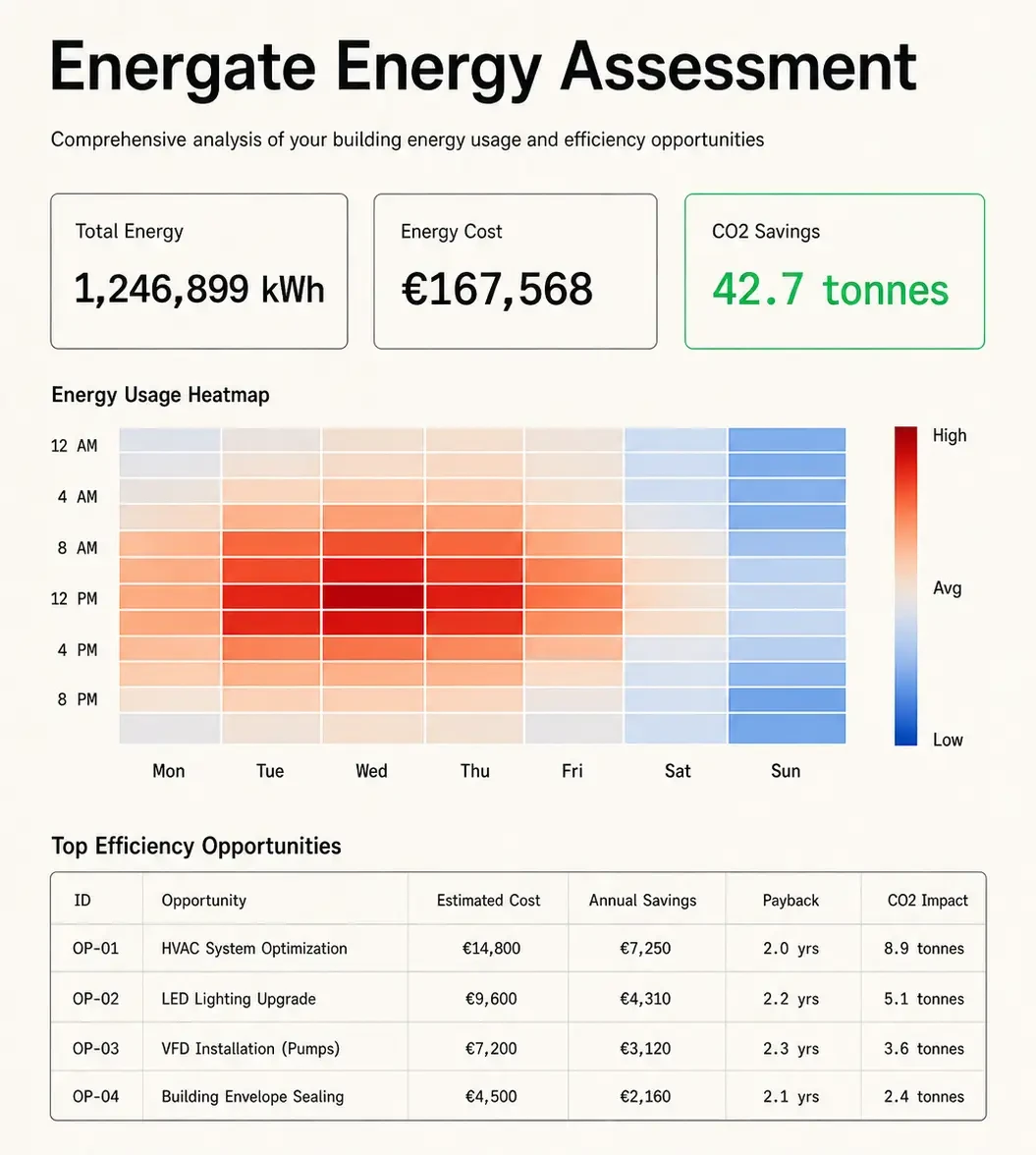
During a free consultation, we'll assess your building's energy consumption and discuss potential energy-saving measures.
Tell us about your building
What is the type and area of your building? Do you have a building management system (BMS)? We'll get back to you within one business day to arrange a personalized consultation. No sales script — just an engineer.
What can Energate do?
What people usually want to know before reaching out.
Hardware installation takes 1–3 days. System configuration time depends on the complexity of the connected systems and the number of integrations.
We use only open industry protocols — BACnet, Modbus, MQTT, and others. This means we can connect to most BMS, utility meters, and sensors on the market without additional licenses or proprietary solutions.
Yes — on two levels. First, we read metering device data directly from utility meters. Second, using individual metrics we can allocate specific costs — e.g. cooling, heating, or ventilation — by zone, tenant, or owner. Accuracy depends on the number and placement of available metrics in the building.
Yes. The platform analyses power quality at multiple levels. Simpler cases — voltage fluctuations, current imbalance between phases, reactive power. More complex — harmonic distortion, network resonances, power factor deviations. All of these cause hidden energy losses and accelerate equipment ageing — detecting them early helps avoid both unnecessary costs and unplanned repairs.
Yes. One of the most common sources of oscillations is poorly configured PID controllers used for temperature, pressure, or flow regulation. The system detects characteristic symptoms — periodic fluctuations around the setpoint, overshoots, and unstable cycling. This makes it possible to identify which controllers need P, I, or D parameter tuning, and avoid both energy waste and equipment wear.
Yes. The platform continuously analyses consumption profiles and automatically flags deviations from normal patterns. Several types of anomalies are detected — short-term: sudden load spikes, night-time usage in an empty building, or systems running outside working hours; and long-term: when baseline consumption rises without an obvious reason over weeks. This makes it possible to spot early that an atypical electricity consumer is active in the system, or that an operating schedule has been misconfigured.
Yes. The platform integrates electricity price data — from exchanges such as Nord Pool, or from fixed multi-tariff schemes — and can use it to automatically schedule energy-intensive systems. Heating, ventilation, cooling, and other flexible loads are shifted to cheaper hours, reducing energy costs without sacrificing comfort.